Thursday, February 14, 2013

Tuesday, February 12, 2013 – Our last day

We left our hotel at 4.00 a.m. and found a taxi waiting outside our hotel room which took us to the airport.  Our flight left Bangkok at 7.00 a.m.  For the next 25 hours we went from Bangkok to Tokyo for six hours; from Tokyo to Newark, N.J. for 12 hours; from Newark to Toronto for 1.5 hours.  We then went from the airport to Toronto and then back to Kitchener-Waterloo – Home. 


From 34 degrees C every day for a month back into winter weather  in Kitchener-Waterloo, Canada, we arrived home on Tuesday, February 12 already missing the heat, the food and the chaos of Southeast Asia. 
 

Monday, February 11, 2013 Wat Pho

Today, we decided to return to Wat Pho, beside the Grand Palace to get a massage at the on-site traditional Thai massage pavilion.  The pavilion carries on the temple’s primary purpose as a space for traditional healing.  What an amazing massage we had for less than $15.00 for the hour.  It was well worth getting through the crowds before we got to the Pavilon. 

 We were also very happy that we had been to the Grand Palace previously.  As it turns out the Grand Palace  was crowded with many visitors wanting to pray at the site on  the Chinese New Year.   


We took some time out to explore some of the big malls in Bangkok.  We discovered many beautiful things in the beautiful malls.  It is always very interesting how store clerks are in other countries.  They are very friendly and helpful, following behind you and putting things the things that you have touched back exactly the way they were before you touched them.  It makes you feel as though you should not have touched the articles.

We then took the local ferry back to our neighbourhood to enjoy, yet another amazing Thai meal, our last one before leaving tomorrow.  The ferry ride back was a long ride and very enjoyable in the evening.  We ate at a different restaurant and were again delighted with our food and the ambience.  After dinner I went to the spa for a manicure and pedicure, while Gerald ran errands to prepare for our trip back home. 

Sunday, February 10, 2013 Bangkok


Today, we decided to go to the Chatuchak Weekend Market in Bangkok.  
The market is at the end of the sky train line, traffic is very busy and people are everywhere.   It is among the largest markets in the world. 
 Jatujak or Chatuchak Weekend Market is the biggest market in Thailand and one of the best in Asia. It boasts about 15,000 stalls in its 35 acres and flocked by approximately 200,000 visitors daily. 

 Luckily, we had planned to spend the entire day here as it was a very large market with many things to look at.  The day was very hot but we were able to buy small or large towels (which were kept in the coolers) that helped us cool off.  

The market closed at 7:00 p.m. and we did not get to every stall in the market, which was fine with us at the end of the day. 


We decided to go to the very busy/funky street, in our neighbourhood, for dinner.  It is a narrow street with little traffic, except for people.  There are many restaurants here and places for people to lie on lounge chairs while they get a foot massage or a thai massage.  There are also many spas to get a facial, manicure and pedicure, etc. for an extremely inexpensive amount.  


There are also Volkswagen Vans which have been converted into small bars offering all sorts of mixed drinks, beer and interesting music to listen to.  

There are people everywhere from different countries  taking in all that the street has to offer.  We had, yet another, fantastic meal in a fun, energetic atmosphere.

Sunday, February 10, 2013

Saturday, February 9, 2013 Bangkok


We awoke early this morning to go out, explore Bangkok again and pick up some clothing we had ordered to be made.  Our room is on the top 5th floor of the G.H. with a small balcony looking out into large, tall trees.  It had rained in the evening and we had missed it.

In the afternoon we went to China Town to celebrate the Chinese New Year.  It is a large China Town, along the river, filled with many restaurants, shops and many, many people dressed in red celebrating.  We ate dim sum for dinner  to give us a taste of home.   We caught the local boat  back to the area our G.H. is in.  It was a lovely ride in the evening and a short walk to our G.H.  What a lovely day it was -- there seems so much to do and so little time. 

The Chinese have bid adieu to the Year of the Dragon and gracefully welcomed the Year of the Snake. The Chinese New Year 2013 has been enthusiastically celebrated across the world, to mark the arrival of the Water Snake - which Chinese astrology considers powerful and associated with the notion of Karma.


Friday Feb 8th, 2013 Tubtim to Bangkok


This morning we had another delicious breakfast in an idyllic setting on the beach before we went back to our G.H. to pack our things to return to Bangkok in preparation for our journey back home.


We had quite the hike, with our knapsacks, to the next cove where we caught the ferry back to Ban Phe.  On our ferry ride we met a fellow traveller from Kitchener and from Nepal.  Small world -- isn't it.


We arrived in Bangkok close to 7.00 p.m.  We had previously booked our Guest House before leaving on our travels -- which made our return to the city very easy.

 This time our G.H. is in the famous neighbourhood of Banglamphu, which includes the backpacker street of  Khao San Road.    This area is a very busy, booming part of Bangkok filled with backpackers from around the world.

Monday, February 4 toThursday, February 7, 2013. Ko Samet, Thailand

The next three days were spent at Ao Tub Tim cove on Ko Samet -- sunning, swimming, reading, hiking, eating amazing seafood and taking in the beautiful scenery of sand, rocks, trees and tub-temperature ocean.


Sunday, February 3, 2013 Siem Reap, Cambodia to Ko Samet, Thailand

Today, we spent the day exploring the city of Siem Reap.

In the evening, we went to the famous Pub Street, within walking distance of our G.H.

It is another truly unbelievable place.  As it has grown, Siem Reap has transformed from a sleepy overgrown village to an international destination for the 'jet set'.  Siem Reap is now firmly on the nightlife map of southeast Asia.  In the night it feels more like a beach town than a cultural capital.  Pub Street has a huge sign indicating its location.  The street is closed to traffic every evening.  It is a place where you can wine and dine very cheaply but have a meal fit for a King and Queen and be treated like royalty -- the choices are overwhelming -- all amazing.

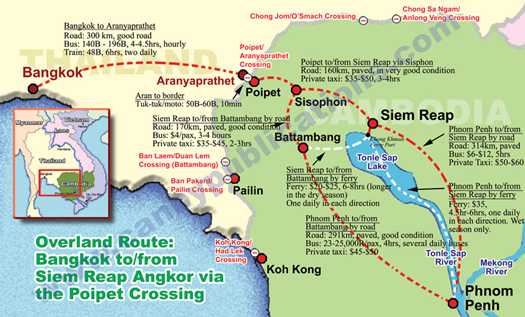
Having enjoyed Pub Street immensely we returned to our G.H. to pack up for a very early morning start at 1.45 am. to catch an overnight bus from Siem Reap, Cambodia to Bangkok, Thailand.

Lucky for us we were able to sleep soundly on the bus and we awoke at the border at 7.00 a.m. At the border it took us a couple of hours to process our paperwork, cross into Thailand on foot and get into a small bus to take us the rest of the way to Bangkok.

We arrived in Bangkok around 1.00 p.m.  After some 'travel confusion' we caught a taxi to take us to the bus station we needed to get to o catch a bus to Ban Phe four hours south of Bangkok as we headed to the beach for some rest and relaxation.


At Ban Phe we caught a ferry over to Ko Samet.  Ko Samet is an idyll island with beautiful scenery, small sandy coves and clear aquamarine water.

 We decided to go to Ao Tub Tim cove which is a favourite beach for solitude seekers who need access to civilization, if necessary, but not a lot of other stimulation.  We knew if we wanted more stimulation we could hike to it.

Wednesday, February 6, 2013

Sat Feb 2nd, 2013 Angkor Wat, Cambodia


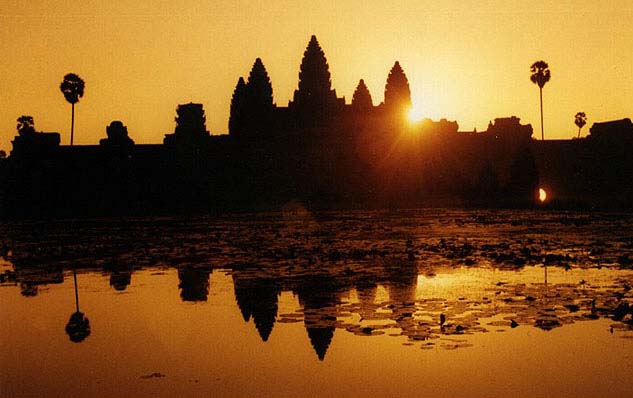
The next morning our driver met us at 5.00 am. and we proceeded to Angkor Wat, in the dark with flashlights in hand. to view the sunrise.
It was amazing to see Angkor Wat reflected in the water/pool/moat as the sun came up.


Having this beautiful experience, we proceeded back on the 'Big Circuit' beginning at Angkor Thom.  Angkor Thom is a 'Great City' on an epic scale.  It was the last great capital of the Khmer empire and set over 10 sq km, Angkor Thom took monumental to an entire new level.  it was built in part as a reaction to the surprise sacking of Angkor by the Chmas after Jayavarman VII (1181-1219) decided that his empire would never again be vulnerable at home.  Beyond the formidable walls is a massive moat that would have stopped all but the hardiest invaders in their tracks. Angkor Thom is enclosed by a jayagiri (square wall) 8m high and 12km in length and encircled by a 100m wide jayasindhu (moat).  The gates are flanked by a vast representation of the Churning of the Ocean of Milk, 54 demons and 54 gods engaged in an epic tug of war on the causeway.

We then headed out of town to see another  temple.  On our journey, we passed many 'cottage industries' of wood cutters, palm sugar producers (similar to maple syrup production), basket weavers, gasoline merchants selling their wares in reused two-litre pop bottles and many food merchants.  We then headed back to the Temples of Angkor for lunch before going to the Temple of Angkor Wat.

Having had another wonderful Cambodian meal, we headed to Angkor Wat.  The first sight of Angkor Wat is simply staggering and is matched by only a few select spots on earth such as Macchu Picchu or Petra.  Angkor Wat is, quite literally, heaven on earth.

Angkor Wat is the perfect fusion of creative ambition and spiritual devotion.  It is believed to be the worlds' largest religious building, the 'mother' of all temples.  The temple is the heart and soul of Cambodia.  It is the national symbol, the epicentre of Khmer civilization and a source of fierce national pride.
 It soars skyward and is surrounded by a moat 'that would make its European castle counterparts blush'.

 It is unique and a stunning blend of spirituality and symmetry, an enduring example of man's devotion to his gods.

It is truly an unbelieveable feeling when you first approach the Temple and then emerge on the inner causeway.  Exploring the temple there is a sense of continuous awe and disbelief at the incredible sight you are visiting/viewing. 


We spent a few hours taking in Angkor Wat and feeling very fortunate to have the opportunity of taking a few hours to 'take in' the site.  Again, what an amazing day.


Having spent the afternoon absorbing Angkor Wat, we felt we could leave knowing that we had absorbed what we wanted to at the site.  Our T.T. driver suggested that we take a drive outside of Siam Reap and see the Floating Village.  We had heard about the Village, but had no idea what it was about.  Nevertheless, we were open to the experience -- so off we went.

We drove about a half hour out of town and as we did, the houses were built more and more on stilts.  The driver explained that in the rainy season the area is completely flooded.  As we drove out, the road was very dry and dusty and the neighbourhoods seemed to get poorer.  We drove all the way to the beginning of Tonle Sap Lake.

 Tonle Sap Lake is on the south of Seim Reap Town, some 19 km away.  Here, we bought a ticket at the ferry landing for a ride on one of the boats to the Floating Village.    As it turns out, we were the only two people on a large boat manned by the driver and his 12-year old 'helper'.

There are as many as 1,115 families living in the Floating Village.  Our T.T. driver told us that there were approximately 450 Vietnamese families and 300 Cambodian families living in the Village.   As we rode up to the Village, we were very much aware of how brown the water is from the soil in it.  Our cost for the boat ride aides the Village with any medical costs and funeral costs that might arise that the families cannot afford to deal with.  During the rainy season the water in the lake rises some 12 m high.  The Floating Village moves from place to place making a living fishing.  The lake is a fresh water lake and there are some 200 species of  fish and birds in and around the lake.


For most of the year the lake is fairly small, around one metre deep and with an area of 2,700 square km. During the monsoon season, however, the Tonlé Sap river, which connects the lake with the Mekong river, reverses its flow.

Water is pushed up from the Mekong into the lake, increasing its area to 15,000 square km and its depth to up to nine metres, flooding nearby fields and forests. The floodplain provides a great breeding ground for fish.


The pulsing system with its large floodplain, rich biodiversity, and high annual sediment and nutrient fluxes from Mekong makes the Tonlé Sap one of the most productive inland fisheries in the world, supporting over three million people.[dubious ]
At the end of the rainy season, the flow reverses and the fish are carried downriver.


We were truly exhausted, having woken up so early in the morning to see the sunrise.  As we headed back to our G.H. we looked forward to another wonderful Thai dinner, some relaxation in our beautiful G.H. and sleeping in the next morning.

Friday, February 1st, 2013 Siem Reap, Cambodia


We leave our hotel room 6.00 a.m. in the morning in a Tuk Tuk heading toward the airport.  It was still dark and everyone was on their way to work.  Lucky for us (?) we were going in the opposite direction.  On a very narrow bridge, our Tuk Tuk had to stop often to let the other side go by as both of us would not fit the width of the bridge.  Our flight was great.  Laos Airlines manages to feed us a 'meal' on a one-hour flight.  They automatically put the tall men at the front of the small airplane so that they would have room for their legs.

We arrived at Siem Reap and began the task of finding a Guest House.  The search seemed long and tiring in the very hot weather.  It seems that each location we arrive at brings on another layer of even hotter weather.

 Gerald found a Tuk Tuk driver who would drive him around for a $1.00 to look for a Guest House.

 He found one in the Psar Chaa part of town, which is where we wanted to stay.  The Villa Medamrei was an oasis in the dessert.  It has an eye-catching exterior which sets the tone for a stylish and affordable boutique stay.  The room included a flat-screen TV and bright silk decor, beautiful ponds/gardens and reclining spaces with a very attentive staff.  We were welcomed with a drink and treats when we checked in.  The Guest House was a welcomed change from some of our previous accommodations.

Having checked in, we hired the Tuk Tuk driver for the next two days to begin our visit and exploration of the Temples of  Angkor.


Angkor is the earthly representation of Mt. Meru, the Mt. Olympus of the Hindu faith and the abode of ancient gods.  The temples are the perfect fusion of creative ambition and spiritual devotion.  The Cambodian 'god-kings' of old each strove to better their ancestors in size, scale and symmetry, culminating in the world's largest religious building, Angkor Wat.

The temples of Angkor are a source of inspiration and national pride to all Khmers as they struggle to rebuild their lives after years of terror and trauma.  Today, the temples are a point of pilgrimage for all Cambodians, and no traveller to the region will want to miss their extravagant beauty.  Angkor is one of the world's foremost ancient sites, with the epic proportions of the Great Wall of China, the detail and intricacy of the Taj Mahal and the symbolism and symmetry of the pyramids, all rolled into one.  It is truly an unbelieveable, breath-taking experience to visit these sites.  

The Angkorian period spans more than 600 years from AD 802 to 1432.  This incredible age saw the construction of the temples of Angkor and the consolidation of the Khmer empire's position as one of the great powers in southeast Asia.  This era encompasses periods of decline and revival and wars with rival powers in Vietnam, Thailand and Myanmar.  This brief history deals only with the periods that produced the temples that can be seen at Angkor.
The hundreds of temples surviving today are but the sacred skeleton of the vast political, religious and social centre of Cambodia's ancient Khmer empire, a city, that at its peak, boasted a population of one million when London was a small town of 50,000.  The houses, public buildings and palaces of Angkor were constructed of wood - now long decayed - because the right to dwell in structures of brick or stone was reserved for the gods.

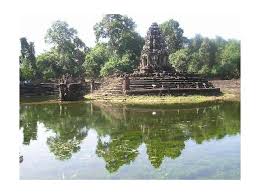
To begin our visit at the Temples of Angkor, we decided to take the Tuk Tuk driver's suggestion and do what is called the 'Big Circuit'.  The 'Big Circuit' of the Temples of Angkor is 26km and is an extension of the Small Circuit, which is 17 km.  As part of the 'Big Circuit' we explored the Buddhist-Hindu fusion temple of Preach Kan and the ornate water temple of Neak Poan, Ta Prohm, the Ta Prohm before continuing to the temple pyramid of Ta Keo, the Buddhist monastery of Banteay Kdei and the immense royal bathing pond of Sra Srang.
The name means royal bathing pond. The first lake, built in the 10th century, may have been larger. This lake, built during the reign of Jayavarman VII, is about 400 by 700 meters, and is bordered with steps and a stone facing. It is across the road from the east entrance to Banteay Kdei, the Buddhist sanctuary also built by Jayavarman VII. Originally there may have been a small island sanctuary in the center of this tranquil "baray" since blocks of large stones have been found in the water there. 


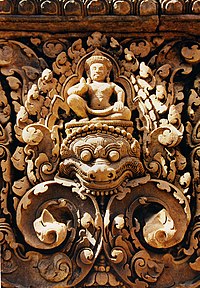
Next we ventured to Banteay Srei temple, the jewel in the crown of Angkorian art and Beng Mealea, a remote jungle temple. Consecrated on the 22nd of April, 967 A.D.[4], Bantãy Srĕi was the only major temple at Angkor not built by a monarch; its construction is credited to a courtier named Yajnavaraha / Yajñavarāha (modern Khmer: យជ្ញវរាហៈ), who served as a counsellor to king Rājendravarman II (modern Khmer: ព្រះបាទរាជេន្រ្ទវរ្ម័ន).
The temple's modern name, Bantãy Srĕi — citadel of the women, or citadel of beauty — is probably related to the intricacy of the bas relief carvings found on the walls and the tiny dimensions of the buildings themselves.[6] Some have speculated that it relates to the many devatas carved into the walls of the buildings.[7]


Beng Mealea or Bung Mealea (Khmer: ប្រាសាទបឹងមាលា, its name means "lotus pond"[1]) is a temple in the Angkor Wat style located 40 km east of the main group of temples at Angkor, Cambodia, on the ancient royal highway to Preah Khan Kompong Svay.
Its primary material is sandstone and it is largely unrestored, with trees and thick brush thriving amidst its towers and courtyards and many of its stones lying in great heaps.


Upon the suggestion of our driver , we then proceeded to walk uphill,  then climb the Phnom Bakheng ancient temple to view the sunset.

  It is an incredible feeling to be perched high on an ancient temple overlooking the city Siam Reap and Angkor Wat as the sun goes down.

 What an amazing day it was.  Before saying goodbye to our driver for the evening, we made arrangements for him to pick us up at 5.00 am. to view sunrise at Angkor Wat.

The evening was spent exploring Siam Reap, which included a delicious Cambodian dinner and visiting the Night Market.  The Night Market is packed with stalls selling a variety of handicrafts, souvenirs and silks.

 It is also possible to get a foot massage, a back massage and have fish eat the dead skin off your feet if you wish at the very busy market.