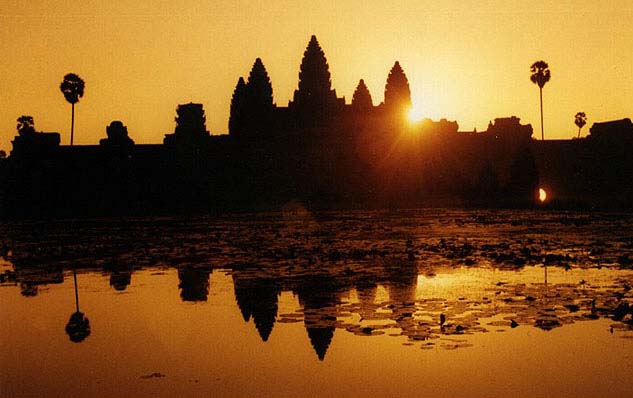
The next morning our driver met us at 5.00 am. and we proceeded to Angkor Wat, in the dark with flashlights in hand. to view the sunrise.
It was amazing to see Angkor Wat reflected in the water/pool/moat as the sun came up.
 Having this beautiful experience, we proceeded back on
the 'Big Circuit' beginning at Angkor Thom. Angkor Thom is a 'Great
City' on an epic scale. It was the last great capital of the Khmer
empire and set over 10 sq km, Angkor Thom took monumental to an entire
new level. it was built in part as a reaction to the surprise sacking
of Angkor by the Chmas after Jayavarman VII (1181-1219) decided that his
empire would never again be vulnerable at home. Beyond the formidable
walls is a massive moat that would have stopped all but the hardiest
invaders in their tracks. Angkor Thom is enclosed by a jayagiri (square
wall) 8m high and 12km in length and encircled by a 100m wide jayasindhu
(moat). The gates are flanked by a vast representation of the Churning
of the Ocean of Milk, 54 demons and 54 gods engaged in an epic tug of
war on the causeway.
Having this beautiful experience, we proceeded back on
the 'Big Circuit' beginning at Angkor Thom. Angkor Thom is a 'Great
City' on an epic scale. It was the last great capital of the Khmer
empire and set over 10 sq km, Angkor Thom took monumental to an entire
new level. it was built in part as a reaction to the surprise sacking
of Angkor by the Chmas after Jayavarman VII (1181-1219) decided that his
empire would never again be vulnerable at home. Beyond the formidable
walls is a massive moat that would have stopped all but the hardiest
invaders in their tracks. Angkor Thom is enclosed by a jayagiri (square
wall) 8m high and 12km in length and encircled by a 100m wide jayasindhu
(moat). The gates are flanked by a vast representation of the Churning
of the Ocean of Milk, 54 demons and 54 gods engaged in an epic tug of
war on the causeway. We then headed out of town to see another temple. On our journey, we passed many 'cottage industries' of wood cutters, palm sugar producers (similar to maple syrup production), basket weavers, gasoline merchants selling their wares in reused two-litre pop bottles and many food merchants. We then headed back to the Temples of Angkor for lunch before going to the Temple of Angkor Wat.
Having had another wonderful Cambodian meal, we headed to Angkor Wat. The first sight of Angkor Wat is simply staggering and is matched by only a few select spots on earth such as Macchu Picchu or Petra. Angkor Wat is, quite literally, heaven on earth.
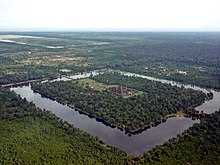
It soars skyward and is surrounded by a moat 'that would make its European castle counterparts blush'.
It is unique and a stunning blend of spirituality and symmetry, an enduring example of man's devotion to his gods.

It is truly an unbelieveable
feeling when you first approach the Temple and then emerge on the inner
causeway. Exploring the temple there is a sense of continuous awe and
disbelief at the incredible sight you are visiting/viewing.
We spent a few hours taking in Angkor Wat and feeling very fortunate to have the opportunity of taking a few hours to 'take in' the site. Again, what an amazing day.
Having spent the afternoon absorbing Angkor Wat, we felt we could leave knowing that we had absorbed what we wanted to at the site. Our T.T. driver suggested that we take a drive outside of Siam Reap and see the Floating Village. We had heard about the Village, but had no idea what it was about. Nevertheless, we were open to the experience -- so off we went.
We drove about a half hour out of town and as we did, the houses were built more and more on stilts. The driver explained that in the rainy season the area is completely flooded. As we drove out, the road was very dry and dusty and the neighbourhoods seemed to get poorer. We drove all the way to the beginning of Tonle Sap Lake.
There are as many as 1,115 families living in the Floating Village. Our T.T. driver told us that there were approximately 450 Vietnamese families and 300 Cambodian families living in the Village. As we rode up to the Village, we were very much aware of how brown the water is from the soil in it. Our cost for the boat ride aides the Village with any medical costs and funeral costs that might arise that the families cannot afford to deal with. During the rainy season the water in the lake rises some 12 m high. The Floating Village moves from place to place making a living fishing. The lake is a fresh water lake and there are some 200 species of fish and birds in and around the lake.

Water is pushed up from the Mekong into the lake, increasing its area to 15,000 square km and its depth to up to nine metres, flooding nearby fields and forests. The floodplain provides a great breeding ground for fish.

The pulsing system with its large floodplain, rich biodiversity, and high annual sediment and nutrient fluxes from Mekong makes the Tonlé Sap one of the most productive inland fisheries in the world, supporting over three million people.[dubious ]
At the end of the rainy season, the flow reverses and the fish are carried downriver.
We were truly exhausted, having woken up so early in the morning to see the sunrise. As we headed back to our G.H. we looked forward to another wonderful Thai dinner, some relaxation in our beautiful G.H. and sleeping in the next morning.

No comments:
Post a Comment