Thursday, January 31, 2013

Thursday, January 31, 2013 Savannakhet, Laos


This morning we said goodbye to our friends hoping that we might see them again in Bangkok on February 9th in Chinatown.  We had hoped to catch a flight to Cambodia today.  But as with many plans, when you are travelling, things can change.   As it turns out there was no flight to Cambodia from Savannakhet.
We had to take the bus to Pakse, some five hours away to fly to Cambodia.  So, we hopped onto a local bus and arrived in Pakse around 4.00 p.m.
We found an adequate hotel and tomorrow morning we leave at 6.00 a.m. for our 8.00 a.m. flight to Siem Riep. 

Wednesday, January 30th, 2013 Ban Kong Lo, Laos


This morning we left the beautiful village of Ban Kong Lo by local bus.
An hour later we caught the VIP bus on the main highway heading to Savannakhet which is some six hours away.  Together with our two fellow travellers we found a hotel in Savannakhet to spend the night.  All of us planned to leave the next day for different places.
We had another lovely dinner with our friends and 'solved all of the world's problems in our evening discussions'.

Tuesday, January 29th, 2013 Vientiane, Laos

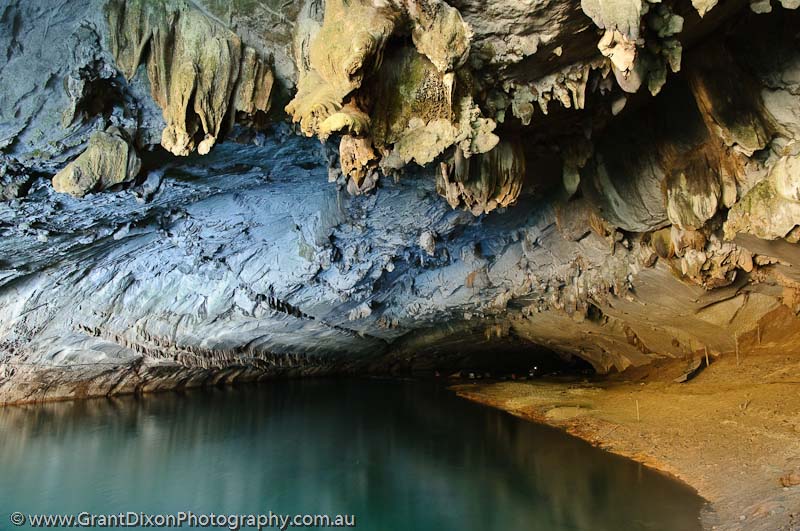
The next morning we proceeded to the 'famous' Tham Kong Lo cave.  Imagine a river disappearing at the edge of a monolithic limestone mountain and running 7km through a pitch-black, winding cave and you will have a sense of the cave --  it is truly one of the natural wonders of Laos.  The cave-cumtunnel is up to 100m wide in some places and almost as high.  It takes a motorized canoe nearly two hours to pass through and an hour to come back.


Boat pilots hired for the journey lead visitors to natural stalagmites and stalactites in a dry cavern branching off the main tunnel.  We were thankful to have powerful flashlights and our flip-flops when we jumped in and out of the canoe.  Besides snaking through the tunnel, the Nam Hin Bun meanders through some spectacular scenery -- gothic mountains and cliffs of jagged black karst.  It is amazing that some hardy trees have managed to take root on the cliffs. 

Getting back from our trip to the cave, we decided to find another restaurant in the village at which we ate a typical Laos lunch and headed out for a hike in the village, using the Nam Hin Bun river as our guide.  We walked along the river and then into the forest with our two fellow travellers and two dogs from the village accompanying us on our exploration. In the forest, we found a buddha embedded high in the cliff.  It was a spectacular sight.  It is difficult to imagine how the buddha got there as it was in an extremely high place.  After our amazing hike, we returned to the restaurant near our Guest House for an evening of fun.  The food in this particular restaurant was delicious.  However, since they only had one pot to cook in, we had to patient as they cooked one meal at a time.

Monday, January 28th, 2013 Vientiane the capital city of Laos.

Our overnight bus was a VIP bus,  like the last VIP bus we had in Thailand.  We survived our bus trip and were happy to arrive in Vientiane on Monday, January 28th, the capital city of Laos.  Vientiane is not a very vibrant city.  It is described as a sleepy, riverside capital with a handful of temples and an armful of good restaurants, cafes and bars.  Here, we waited for our connection, i.e., small truck picking up several others who were going in our direction, and taking us to the bus station to go to our destination Ban Kong Lo from which we would visit the  Tham Kong Lo cave.  The bus ride to Ban Kong Lo was six hours long as we meandered along to our destination stopping at many villages.

We arrived at Ban Kong Lo in the late afternoon and checked into a Guest House.  The Guest House was 60,000 Kip a night ($7.50).  Yes, it did have a toilet and hot water and a beautiful view outside of the shuttered windows.  We then went for a walk with a couple of fellow travellers we had met on the bus. Afterwards, we enjoyed a lovely dinner at one of the local restaurants in the village.  

Monday, January 28, 2013

Sunday, January 27th, 2013: Luang Prabang, Laos

This morning we were up very early at 5:30 a.m. to go see the Tak Bat -- The Monks' Alms Procession daily at dawn.  Saffron clad monks pad barefoot through the streets while pious townsfolk place tiny balls of sticky rice in their begging bowls.  It is a quiet, meditative ceremony through which monks demonstrate their vows of poverty and humility while lay Buddhists gain spiritual merit by the act of respectful giving.

If you are wanting to participate in this ritual it is recommended that you get some Kao Kai Noi (the best grade sticky rice) to be cooked to order by your guesthouse.  Or busy it fresh-cooked from the morning market before the procession.  Carry it in a decent rice-basket, not a plastic bag.  Before arriving, dress respectfully as you would for a temple (covered upper arms and chest, skirts for women, long trousers for men).  Wash your hands and don't use perfumes or lotions that might flavour the rice as you are handing it out; remove shoes; put a sash or scarf across your left shoulder; women should kneel with feet folded behind (don't sit), men may stand; avoid making eye-contact with the monks.

These processions occur all over Laos.  However, old Luang Prabang's peaceful atmosphere and extraordinary concentration of mist-shrouded temples means that the morning's alms procession create a specially romantic scene.  We were embarrassed by some tourists who stuck their cameras into the monks' faces trying to get the perfect picture.  However, the procession we witnessed was a fairly quiet one.

After the procession, we went back to our G.H. and packed our knapsacks and had breakfast.  Then we set out on a walking tour of the town.  We strolled through the morning market once again amazed by the sights we saw, including three-inch cockroaches for sale?

Continuing on our walking tour, we visited the Traditional Arts and Ethnology Centre TAEC.  Here, we learned about northern Laos hill tribes' culture.  Then we proceeded to the That Chomsi Stoupa which is high above the city.  We walked through a very interesting local neighbourhood to get there.  Then we headed along the Mekong Waterfront and had a coffee at one of restaurants along the river taking in the very beautiful view of the river, boats and gardens along the shore of the river.

We crossed the Nam Khan river (which joins the Mekong River) using a bamboo bridge that is only used only in the dry season.  In the rainy season, it is not possible to use the bridge as the water would be above it.  The bridge is not there from June to November. We crossed the river for a well-deserved lunch at the Dyen Sabai.  Here we sat  on recliner cushions in rustic open-sided pavilions that climb the lush wooded slope across the Nam Kham river.  We ate an smoked eggplant dip with an exotic mixture of rice and fish steamed in banana leaf and a pot of green tea -- what a treat of taste and vision.

After lunch we headed back towards our G.H. to pick up our knapsacks.  On the way we visited another Stupa, the famous Wat Xieng Thong.  It is Luang Prabang;s best-known and most visited monastery.


This evening we are catching an overnight bus and going to Vientiane and transferring to another bus going to Tham Kong Lo which is in central Laos as we head towards the border and Cambodia.

Our overnight bus was a VIP bus,  like the last VIP bus we had in Thailand.  We survived our bus trip and were happy to arrive in Vientiane on Monday, January 28th, the capital city of Laos.  Vientiane is not a very vibrant city.  It is described as a sleepy, riverside capital with a handful of temples and an armful of good restaurants, cafes and bars.  Here, we waited for our connection, i.e., small truck picking up several others who were going in our direction, and taking us to the bus station to go to our destination Ban Kong Lo from which we would visit the  Tham Kong Lo cave.  The bus ride to Ban Kong Lo was six hours long as we meandered along to our destination stopping at many villages.


F.Y.I. :  Today is our first 'cloudy' day and we are very thankful for it.

Saturday, January 26th, 2013 Laos, Luang Prabang

Saturday, January 26th, 2013

The next morning (today) we had a lovey breakfast in our G.H. courtyard and then proceeded to a travel agency that was recommended to us by a woman from Morocco who has been staying in Luang Prabang.  We arranged the activities of the next few days.  We then went to explore our area, going to the food market and then going for a street lunch before meeting up with a tour to go to an amazing waterfall outside of the city -- truly the most amazing waterfall site.

On our way back from the waterfall we visited a village before returning to Luang Prabang.  Returning to the 'city', we had dinner and will be visiting the amazing night market which goes on for streets and streets, filled with many beautiful things -- from textiles to antiques to woodworking, etc.

Yesterday at the Saffron Cafe we had an amazing cup of coffee -- look out Starbucks.  The story of S.C. begins with a group of tribes living high in the mountains of northern Laos.  Unable to plant and harvest rice in the lowland paddies like the majority of Lao, these tribet cultivated opium poppy on the mountain slopes and plateaus.

When opium cultivation was outlawed by the Lao government and measures were taken to curb its productions, tribes like the Hmong, Yao (Mien) nd Khmu had little choice but to engage in slash and burn agriculture in order to survive.  In this practice, entire mountinsides are cleared of natural growth and burned off.  Thse upland fields re planted for one season and then abandoned the following year as a new mountainside is cleared, cut and burned.  A new field is cut each year for up to 15 years before the oriinal filed is replanted.  Planting uplnd rice and corn, the harvest is often barely enough to sustain the life of a mountin fmaily.  Without a replacement cash crop for opium, these mountain tribes have succumbed to extreme poverty.

In 2004, David Dale, an American living in Laos, researched the possibility of planting Arabica coffee in northern Oaos.  His research led him to one Hmong village that had already planted coffee as part of an EU project, but had discontinued harvesting the beans for lack of a viable market.  David also explored other highland areas around the World Heritage city Luang Prabang for the possibility of coffee proceduction and found the land to be promising and interest high among the hilltribes.  As a result, Saffron Coffee was born www.SaffronCoffee.com.

Coffee is becoming the first sustainable cash crop for mountain hill tribes since opium.  By purchasing their harvest S.C. now gives the hill tribes choices, i.e., the sick can go to hospital for care and they can buy needed medicines.  They can now also send their children to school without needing to keep them out in the fields because of high maintenance slash and burn agriculture.  


Friday, January 25th, 2013 Chaing Mai to Laos

The last night in Chiang Mai was spent in a very nice hotel -- one of the nicest to date.  In fact, after the home stay, I am convinced that our places will be of great comfort.  The gardens and restaurant were very lovely indeed.

This morning we set out to visit our last temple site in Chiang Mai before going to Laos.  After completing some important travelling tasks, we set out on what turned out to be a very long, time-consuming journey to the site, which was a long distance away.  When we got to the site, it was time for us to leave to go back, get our luggage from the hotel and go to the airport.  It was an amazing race.  We arrived 1.5 hours before our flight left, the recommended time for international departures.  However, the flight was delayed by one hour.  Had we known we could have seen the site -- alas.

Our flight was one hour and ten minutes long.  Long enough for them to serve us a light dinner and free beer -- Lao Airlines is great.  Upon arrival in Laos, Canadians paid $42.00 for a Visa while other nationalities paid less -- interesting.  We were just ready to grab a taxi when we took my knapsack out of its carry bag and noticed it was green not blue -- yikes.  Gerald had grabbed the wrong luggage.  We raced back into the airport and retrieved the blue knapsack.  This was a first but a lucky SAVE.

Driving into Luang Prabang we could not believe the difference from Thailand already, especially in terms of pace.  Magical Luang Prabang is one of Southeast Asia's most alluring destinations. Lacking any world-beating 'sights' it's thoroughly pervaded by a heady charm -- a unique place were time runs slowly amid the fragrances of frangipani and fresh coffee.  Colonial and psuedo-colonial buildings emphasize the tropical with many characterful structures reworked into handicraft stores, patisseries and boutique hotels.  The city is encircled by hazy green mountains a the meeting of the Nam Khan and Mekong River. 


Luang Prabang is an Unesco World Heritage site which means a ban on buses and trucks in the old centre where most road users are on foot or bicycle.  This is not a party destination as Bangkok and Chiang Mai seemed to be in different places in in their locations.  Luang Prabang is Lao's former royal capital with riverside bar-terraces and French restaurants.  The surrounding countryside has plenty of waterfalls and caves to explore.

Arriving in Luang Prabang around 5.30 pm. we began looking for a Guest House to stay at.  The one we were looking for was booked solid for a few days.  However, the Guest House across from it, another very lovely one, had one last room available on the main floor -- it was $25.00 a night, with breakfast included.  The next day, we would be able to move to a room upstairs, which again was very lovely.  We considered ourselves very lucky, as we watched many backpackers pass us by.

We settled into our G.H. and proceeded to explore the town.  They were many restaurants around our G.H.  and the night market was/is very close by.  We went out for a very lovely dinner and then settled in for the night.

Thursday, January 24th, 2013 Karen village to Chiang Mai

Lucky for us we had our silk liners for sleeping.  However, the beds were only blankets on the floor -- somewhat rustic and very hard. All night long we heard the sounds of roosters and pigs grunting.


Thursday, January 24th, 2013

After breakfast this morning, we set out to return to the place we had begun our trek the day before.  This time we took a different route.  Once again, the vistas were spectacular as we walked through the forest.  Today, our trek was less grueling as we were going downhill.  By 1.00 p.m. we arrived at our truck rendevous spot where we had an amazing lunch of Phad Tai with incredible tasting water melon and pineapple.  After lunch we drove to the Bamboo Rafting place where we boarded upon long bamboo rafts and went down the Siam River.  We had one operator and three of us to a raft.  It was soooo lovely.  We did however, get very wet as it is impossible to keep dry as you go down small rapids.  We were very lucky a few times that the raft did not tip.  On our journey, we saw a very large snake on a rock at the river's edge.  We were thankful that the snake was not in the water while we were on the river.  During this trip, we passed some incredible vacation sites on the riverbank.  Unfortunately, we could not take any pictures as we were advised not to bring our cameras and thankfully we didn't.  What a wonderful day.

Following our ride along the river, we returned to Chiang Mai around 5.00 p.m.  Exchanging emails and saying goodby to our fellow travellers we headed to our new hotel to have a shower and go out to dinner to a place that had been recommended to us.  The Thai meal, with beer cost $7.00 for the two of us.  It was again delicious.

After dinner we went to the Chiang Mai night market -- which was somewhat overwhelming with the many stalls selling anything you can think of. It was quite a hike after our very busy day, we decided to walk back to our hotel an enjoy the lovely new room we have. 


Tomorrow is a busy day -- sight seeing, and then leaving for Laos by plane. 

Wednesday, January 23, 2013 Chiang Mai


Here in Chiang Mai it has been 33 degrees and sunny in the daytime and 18 degrees in the evenings. It is has been this temperature since we have been in Chiang Mai.

This morning we had breakfast at our hotel again.  It is very interesting to have eggs with noddles and chicken and salad if you wish, or warm rice in a broth with pork.  We were picked up at 9:00 a.m. by the tour company in a pickup truck with seats in the back.  As we had checked out of our hotel, we left our knapsacks at the tour office taking a light pack with us as we were taking a two-day, one night tour/trek outside of Chiang Mai. 

We picked up the rest of our group, a young woman from France and two young men from Nebraska, all in their late 20's approximately.  We started our tour at an Elephant Camp.  We both sat on the one elephant who seemed to have a mind of his own.  It seems that he was very hungry and would go to many heights to get food.  It is an unbelieveable sensation to be sitting on top of an elephant as he proceeds to climb a hill up and then down -- scary as you cannot believe that the elephant can be so agile and accomplish climbing in a somewhat graceful manner. 

After our elephant adventure, we had lunch.  Lunch was a delicious rice dish.  It would be lovely to know how they accomplished the taste.  After lunch we began our five hour trek in the mountains to the village of the Karen hill tribe.  The trek resembled some parts of the Grouse Grind and some parts of Mt. Everest as we climbed uphill and uphill and uphill.  We passed very tall bamboo trees and poinsetta trees and some farms.  Two-thirds into our journey we stopped at a beautiful spot with a waterfall to cool down and have a break before we proceeded to our final destination.

We arrived at the Karen village around 5.00 pm.  We were shown to our dorm-style accommodations and the toilet (a squatter, no sink or shower, no running water).  We went for a walk in the village to explore the different sights  (uphill,  as the village is built on a hillside).  The village consists of 52 families.  Each home has a solar panel which they have had for some eight years due to the 'Orillia Project'.  When we returned to our host family's home, we went to the kitchen to help with dinner.  Here, in the kitchen, the cook was using a very small fireplace (big enough for one wok).  However, the meal he created was incredible --a chicken curry, and rice and mixed vegetables.  We had homemade rice wine/alcohol with our meal.  It was surprisingly good.  Perhaps, the herbs in the bottle made the difference.

By 9.00 pm. we were all ready for bed after sitting around a fire, in the country quiet, watching the almost full moon in the sky and sharing stories, while our tour leader would break into songs that related to the many parts of our conversations.

Tuesday, January 22nd, 2013: Chiang Mai


We are learning that Thai time of 8.30 a.m. really means 9.00 a.m. -- which we are fine with.
At approximately 8.30/9.00 a.m. this morning, we were picked up by the Aoy Benz, the owner of the Galangal Cooking Studio www.galangalcooking.com
 

At the cooking school, we joined three young single women in their 20's from the Ottawa area who were staying in South East Asia for three months and a young couple from Hong Kong who were visiting Thailand for five days.  Initially, we completed a list of dishes we wanted to make.  Then we were taken to the market to buy the ingredients that we needed to make the various culinary delights.


During the morning and afternoon we made and ate the following dishes:  Green Curry Paste, Massamun Curry Paste (a whole of muscle power, but worth the effort); Hot and Sour Chicken Soup (delicious), Chicken in Coconut Milk Soup (wonderful); Papaya Salad (amazing taste); Minced Pork with Friend Holy Basil (truly unique taste), Pad Thai (what an achievement); Spring Rolls, Fish Cakes (very good); Deep Fried Bananas (amazing), Mango With Sticky Rice (heavenly).  Our instructors were patient, informative and fun.  We completed the day feeling very full, very satisfied, much more knowledgeable about Thai food and cooking  and very motivated to cook Thai food. 

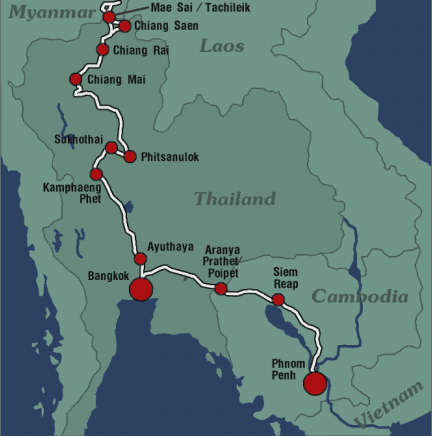
Completing our cooking adventure, we decided to research travel from Chiang Mai to Laos.  It seems that this travel  is not as easy as it would seem as it can take a significant period of time depending upon the mode of transportation.  Our research revealed the options of taking a bus, small van, boat, speed boat and plane.  As we pictured ourselves on a speed boat for some six hours (pictures of our Panama boat trip in our heads), we decided that air transportation was the best option for us given our 'limited' time in South East Asia.  After talking with 'Jack"and a tour agent at our hotel, we booked a flight from Chiang Mai to Laos for January 25th. 

Tuesday, January 22, 2013

Monday, January 21st - Chiang Mai

Our overnight bus trip from Bangkok to Chiang Mai was long.  But, as we were able to sleep during the night bus ride, the journey seemed shorter than the nine hours it took.

Chiang Mia is situated  in the foothills of northern Thailand it is somewhat of a sanctuary with a combination of a city lifestyle and a country perspective.  It is a city of artisans and crafts people, of university professors and students, of idealists and culture hounds creating vibrant, laid-back feeling.   Here, you find scenic countryside and two of Thailand's highest mountain peaks; Doi Inthanon (2565m) and Doi Chiang Dao (2195m).  Chiang Mai boosts of more natural forest cover than any other province in the north. 


Trying to find a place to have breakfast and trying to find a place to stay proved somewhat challenging at 6.00 a.m. in Chiang Mai.  It is unlike Bangkok which never sleeps. 

As the morning passed, we found some coffee and breakfast and a place to stay.  Having checked into our place, we decided to explore Chiang Mai via a walking tour.  We also wanted to explore some options for going on a 'countryside' adventure.  Chiang Mai has many wonderful places to eat, in one of which we enjoyed a delicious vegetarian Thai lunch.  It was exquisite and very inexpensive -- approximately $4.00 for the two of us. 

In our explorations, we found 'Jack' a tour guide who directed us to a cooking school (they are many, many to choose from).  We also arranged an eco tour adventure with him. 

After walking the streets and exploring the various sites in Chiang Mai we decided to get a Thai massage at the Women's Prison Massage Centre.  We passed the Prison on our way to the Massage Centre.  The Prison was a very busy place as people were coming and going out of the facility while vendors outside of the prison were selling various foods and drinks.  Approximately a couple of small city blocks away from the Prison  was the Massage Centre nestled in behind a lovely outdoor garden/restaurant, also run by the Prison.  The Massage Centre is a public outreach program to provide job skills for soon-to-be-released prisoners.  Our massages were given by well-behaved immates who seemed very young and who were very gentle (if a Thai massage, can be gentle).  Our massages ended with a 'secret' spa tea.
The experience was a very relaxing treat for an hour for only $6.60.

Rejuvented by our very lovely spa experience we decided to go to the Th Nimmanhaemi area of Chiang Mai.  This area is close to the University.  It is often referred to as the trendy part of town as it is filled with closet-sized clothing shops and gift boutiques.  Here, we had dinner At 9 Bar, where we sat at an second-storey open air bar/restaurant.  The bar/restaurant gave us a bird's-eye view of the action on The Nimmanhaemin of which there was much -- cars, scooters, motorcyles, tuk tuks, red truck taxis and people everywhere enjoying the warm-evening weather and the various activities of eating, drinking, shopping, etc.

Here, in The Nimmanhaemi, we met a very interesting couple from Britan, who have been coming to Thailand for some 14 years.  They shared many of their travel adventures with us as we compared our stories.  They were very familiar with St. Jacobs and the Mennonites in our area as they have friends in Orangeville that they have visited.  It is, indeed, a very small world.   

Monday, January 21, 2013

Sunday, January 20th - Bangkok

It is difficult to believe that it is January as the weather here in Thailand is at least 30 degrees and it is very sunny all day long.  It seems more like June.


Sunday, being the last day of our stay at the Feung Nakong Balcony Guest House, we treated ourselves to breakfast at the G.H.  It really was a very large breakfast, if you wanted it to be, with many different foods, i.e., eggs, ham, toast, yogurt, museli many different types of fruit and most importantly, coffee -- what a feast.  This breakfast was a considerable change from our previous breakfasts of street food, 7/ll, etc.  After breakfast we packed our knapsacks, put them in storage at the G.H. and proceeded with the plan for the day -- touring the Grand Palace and Wat Pho.  Both of these sites were within easy walking distance from the G.H., as the G.H. street is one of the oldest in Bangkok.

The Grand Palace, also known as as the Temple of the Emerald Buddha, Wat Phra Kaew is the colloquial name of the vaqst, fairy-tale compound that also includes the former residence of the Thai monarch.  Housed in a fantastically decorated boht (temple) and guarded by pairs of yaksha (mythical giants), the Emerald Buddha is the temple's primary attraction.  It sits atop an elevated altar, barely visibl amid the gilded decorations.  The figure is always cloaked in royal robes -- one for each season.  The king, or in recent years, the prince chnges the garments at the beginning of each season.  Recently restored Buddist murals line the interior walls of the boht. 

The largest of the palace buildings is te Chakri Mahaprasat, the Grand Palace Hall that was built in 1882 by British architects using Thai labour.  The exterior of the building is a paculiar blend of Italian Renaissance and traditional Thai architecture.  It's a style often referred bo as farang sai cha dah (Westerner in a Thai crown) because each wing is topped by a heavily ornamented spire representing a Thai adaptation of the Hindu mandapa (Shrine). 

The Crown Palace is truly an unbelieveable site (another one in Thailand).  Pictures cannot capture the overwhelming opulence of the buildings -- gold and glitter, more gold and glitter and more gold and glitter.  As you walk around attempting to capture the immense beauty of this site with pictures you realize that it is not possible to capture the feeling that this site evokes.  Because we visited this site on Sunday, we had the opportunity to witness many Buddha worshippers praying in various locations during our tour. 

After we toured the Grand Palace compound, we walked over to the Wat Pho, home to the genuinely impressive Reclining Buddha, 46m long and 15 m high, the Buddha illustrates the passing of the Buddha into nirvana (i.e., the Buddha's death).  The figure is modelled out of plaster around a brick core and finished in gold leaf.  Mother-of-pearl inlay ornaments the feet, displaying 108 different characteristics of a Buddha. 

Wat Pho is also the national headquarters for the teaching and preservation of traditional Thai medicine, including Thai massage, a mandate legislated by Rama III when the tradition was in danger of extinction.   At Wat Pho we witnessed a Buddhist prayer ceremony with approximately a dozen monks chanting -- it was magical.  These sites left us speechless in terms of witnessing spectacular visions.

Following our explorations, we returned to our G.H. to retrieve our knapsacks and go to the bus station to catch our overnight bus to Chiang Mia.  Our two-storey Frist Class bus arrived and we boarded at 8:45 pm.  We wondered why everyone was wearing jackets in the heat at the bus station. We realized why people were dressed more warmly in the bus station when we arrived in Chiang Mia at 6.00 a.m. We experienced a temperature drop having travelled nine hours north. 

Sunday, January 20, 2013

Sat. Jan 19th - Bangkok

Today, we had intended to visit the Grand Palace, then take the Sky Train to the famous weekend Market.  But, when travelling, plans can and do often change depending upon the events of the day.

Before heading out on our planned day, we attempted to get bus, train ticket to Chiang Mai in Northern Thailand at the G.H. desk.  This proved futile as it seems the tickets were sold out. This seemed like a significant setback in our plans.  So, we decided to go to the train station to get a ticket.
The train tickets were sold out, so we proceeded to the bus station where we were successful in getting tickets for the overnight bus to Chiang Mai.


Before heading out into Bangkok, we went back to the street market, near our hotel.  We ate at one of the local restaurants/street 'cafe'.  We had the traditionally Thai soup sitting across from a very quiet police officer beginning his day with breakfast.  The meal cost us $$3 total including our drinks. 

As our plans had changed, we decided to go to the Sukhumvit area to find a tailor to sew some clothing for us.  We found the C&P Tailors, two sisters who have been in the business some 45 years.  The oldest sister was soon retiring as she is 75 years old.  We ordered our clothing to be picked up upon our return to Bangkok on February 8th.  The sisters told us that they would be closed during the Chinese New Year on February the 9th. 

As we were close to the areas in Bangkok famous for their malls.  We decided to explore Malls Bangkok style.  Truly, it is an unbelieveable sight.  The Siam Paragon is the biggest and glitziest of Bangkok's shopping malls.  It is more of an urban park than a shopping centre.  When we attempted to find the Food Court in the basement or third floor, we were told that the Food Court was on the 6th and 7th floor of the Mall.  The Food Court was truly worth seeing.  It gives more meaning to opulent as we found out when we had lunch there. 


We decided to view the MBK Centre known to be the cheapest place to buy mobile phones and accessories.

MBK Center, also known as Mahboonkrong (Thai: มาบุญครอง), is a large shopping mall in Bangkok, Thailand. At eight stories high, the center contains around 2,000 shops, restaurants and service outlets, including the 4-story Tokyu department store.

It was another colossal mall of some seven floors filled with anything and everything you could think of. 

 After a day of 'sightseeing' we decided to head back to the Banglamphu area for dinner upon the recommendation of an Australian traveller.  The cab fare cost us $2.50 for about a half-hour ride.

 The Hemlock restaurant provided us with yet another excellent Thai meal for $3 each together with a very lovely atmosphere.

We then explored the area's nightlife which was very exciting -- places to shop, places to drink, places to hear bands, places to get foot massages on the sidewalk.  It was the scene of a lively beach resort on steroids in the city, tables for people all over the sidewalks and the streets. 

Friday, January 18, 2013

Friday, January 18th Outside Bangkok


This mornings we were scheduled to meet up for a tour at 7:00 am.  As our hotel would not have breakfast ready before this time, we were encouraged to go to the market (around the corner) to get some breakfast.  Mornings are always very busy in warmer countries -- the day begins early.  This morning we left the hotel while it was still dark.  The day lightened as we begun our breakfast search in the market.  It is an amazing market very close to our Guest House.  We walked for some time trying to find things that looked 'safe' to eat.  The large pots filled with soups were not boiling yet so we passed on them.  After walking around the markets watching them begin their cooking in large pots, we decided that the food may not be cooked enough for us.  We proceeded the the 'safe' 7/11 for some highly processed food.  Instead, we settled for a 'breakfast'  (I use the term loosely) to go with instant coffee (yuk). (We are in the early days of our adventure and need to learn more about the safety of food, markets, etc.)


We were back at the Guest House at 7:00 a.m. and were whisked away in a van to begin our journey to the sights were were scheduled to see that day.  We had a bit of a hiccup, when I realized that I had left my passport in the room.  (This was a first for me.)     One of the tour guides, anxious himself about my passport, arranged for someone to take me back to the G.H. and retrieve my passport and then proceed with our journey. 

We arrived at Ayuthaya about an hour north of Bangkok to begin our guided tour. Ayuthaya was the capital of Siam between 1350 and 1767.  It was a major trading port during the time of the trade winds, international merchants visited and were left in awe of the hundreds of glittering temples and treasure-laden palaces.  At one point the empire reuled over an area larger than England and France combined.  Ayjuthaya has 33 kings who engaged in more than 70 wars during its 417-period; however fine diplomatic skills also ensured no Western power ever ruled Siam (Thailand). 

The last of the empire's battles was in 1767 when an invading Burmese army sacked the city, looting most of its treasures.  What was left continued to crumble until major restorations work began.  In 1991 Ayuthaya's ruins were designated a Unesco World Heritage Site.
For an easier way to visualize our tour, the sites were divided into 'on the island' and 'off the island' sections. 

The first site we visited was Phu Khao Thong (the northwest of the island).  It was originally built by the Burmese during a 15-year occupation of Ayuthaya but was later retrofitted by the Thais to celebrate the occupier's ouster. 
 
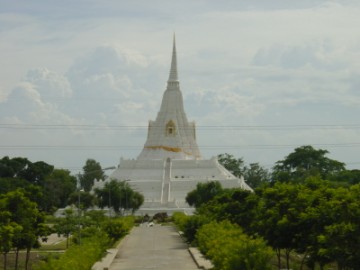
Our full day tour Ayutthaya an ancient captial city consisted of a visit to Wat Phu Khao Thong or the “Monastery of the Golden Mount”.  This temple is located outside the city of Ayutthaya.  It was built by King I-Thong in 1357 for meditation.  In  1592 King Naresuan defeated the Burmese crown prince.  He commanded a large pagoda be built at this temple to match the height of the temple.  


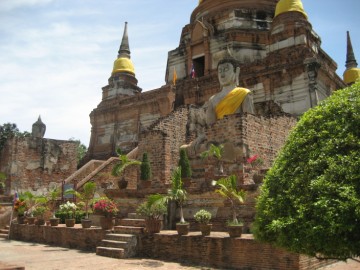
The next site we visited was the Wat Yai Chai Mongkhon (east of isaldn) a 7m-long reclinging Buddha is the defining feature of this temple, built by King U in 1357 to house Sri Lankan monks.  The bell-shaped chedi (stupa) was later built to honour King Naresuan's victory over Burma. 
 
We also visited Wat yai Chai mong khon or the “Great Monastery of Auspicious Victory” thai temple is located outside the city of Ayutthaya. Evidence of a large moat that once existed around the site suggests that it was once an important Khmer-style temple complex in “Ayodhya,” a settlement that pre-dated the Ayutthaya Kingdom.  


The tall chedi that stands an estimated 30 meters (100 feet) is almost as high as the one at Wat Phu Khao Thong; its more slender profile that rises in the middle of urban Ayutthaya obscures its true height.

Today it’s a functioning temple with a monastery and restored stupa or chedi (monument). Several smaller chedi ruins dotting the grounds serve as a reminder that the site is historical.

 It was built by King U-thog in 1357 for meditation.  


We also visited the ancient palace and Wat Phra Si Sanphet.  It was the Thai capital for 417 years.  Wat Phra Sri Sanphet is situated on the city island in Ayutthaya’s World Heritage Park in Pratu Chai sub-district. It has been registered as a national historic site by the Fine Arts Department since 5 March 1935. This monastery was the most important  temple of Ayutthaya and situated within the Royal Palace grounds. It served as a model  for the Temple of the Emerald Buddha in Bangkok.
Wat Phra Si Sanphet was situated on the premises of the royal palace which had been established in the reign of King Ramathibodi I (King U - Thong). In 1448 King Boroma-Tri-Loka-Nat dedicated the site of the palace to the construction of the temple. The important edifices in this temple are the three main stupas containing the ashes of King Boroma-Tri-Loka-Nat, King Boroma-Rachathirat III and King Ramathibodi II. It was a royal temple Kingdom of Ayutthaya, used for such important royal ceremonies as swearing allegiance and it also served as the royal family's private chapel and the place where the royal family's ashes were preserved. 

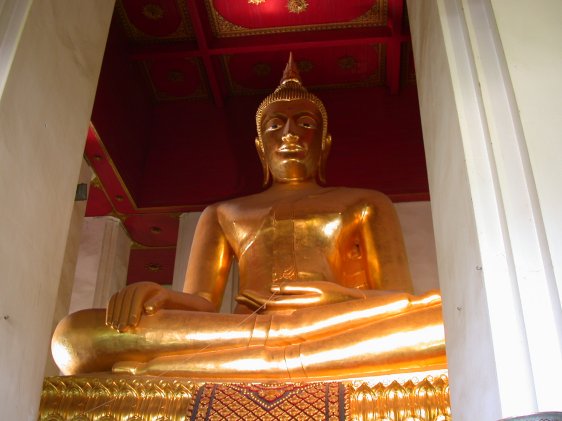
On the island we visited Wihaan Mongkhon Bophit which houses one of the largest bronze Buddha images in Thailand.  The 17m-high figure has undergone several facelifts due to lightning strikes and fire.  In 1955 the Burmese Prime Minister visited and donated 200,000B  (some $7,000) to help restore the building, an act of belated atonement for his country's sacking of the city 200 years earlier.   Viharn Phra Mongkol Bopit is one of the largest bronze buddha's in Thailand. The main Buddha image inside the building is a very huge bronze cast Buddha image named Phra Mongkol Bopit. It was originally enshrined outside the Grand Palace to the east, previously sitting at Wat Chichiang intended to stand in the open air. It was later relocated to the present position and covered with a Mondop building. In 1990, the provincial administration of Ayutthaya obtained permission from the Fine Arts Department to cover the statue with gold leaf to commemorate the 60th birthday of Her Majesty the Queen. 

We took a lunch break consisting of traditional Thai food and then proceeded  to Wat Lokaya Sutha.
 

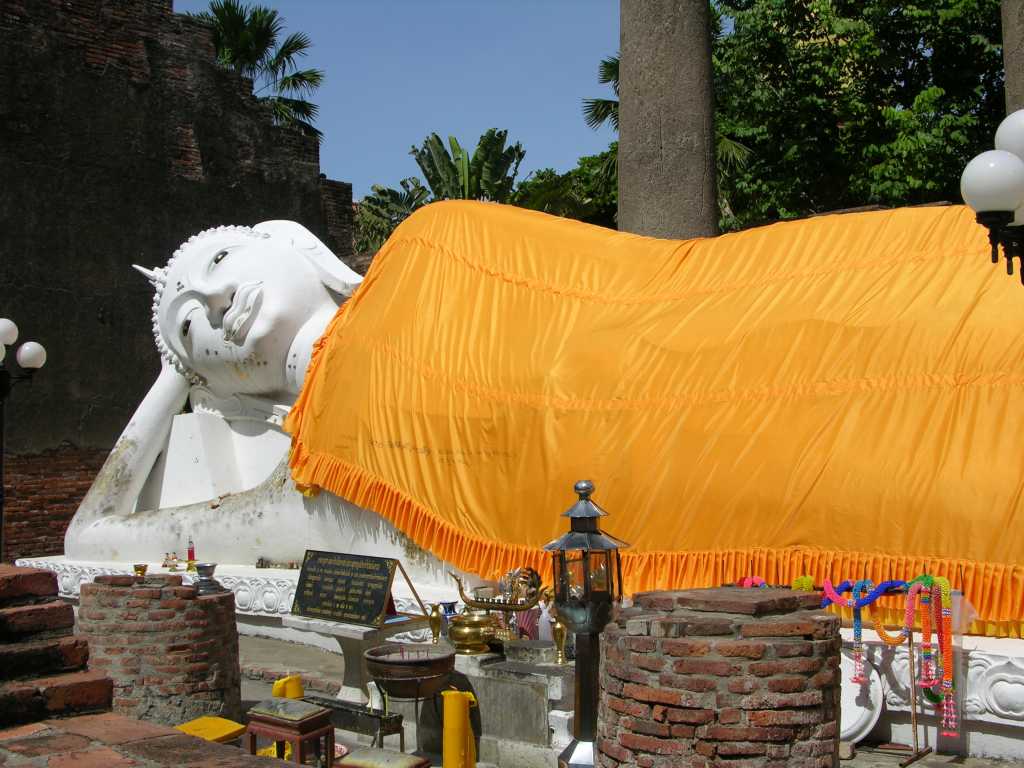
 This temple is adjacent to Wat wora-chettharam in the west to the city.  It housed a large reclining Buddha statue made of brick and covered with plaster. The reclining Buddha is 42 meters in  length and 8 meters high, and its name is "Phra Buddha Sai Yat". The reclining Buddha  image is aligned to a north/south axis, and it is facing west. All the Buddha’s toes are of  equal lengths. The arm supporting the head is vertical, instead of being folded as in the  Early Ayutthaya and U-Thong periods. This vertical arm is a characteristic of reclining  images made in the Middle Ayutthaya period - after the 16th century (Amatyakul 47). The reclining Buddha image is usually wrapped in brightly colored orange cloth.


We then visited the most photographed image in Ayuthaya, Wat Phra Mahathat.  The sandstone Buddha head lies mysteriously tangled within a tree's entwined roots.  Built in 1374 during the reign of King Borom Rachathirat I, it has rows of headless Buddha images.  No one knows for certain how the Buddha head ended up in the tree.  Some say the head was abandoned after the Burnese sacked Ayuthaya and trees subsequently grew around it.  Others believe that thieves tried to steal the image, but gave up as it was too heavy.  

After a day of being immersed in Buddha images, temples and stupas,  we were dropped off in a different part of Bangkok "accidentally".  
 

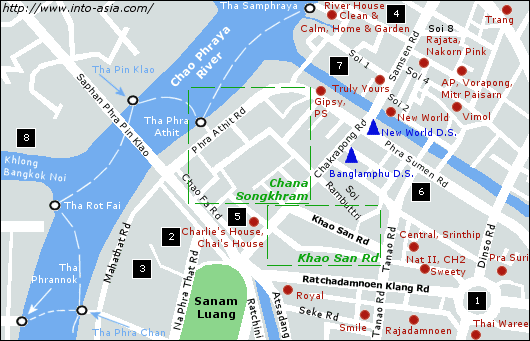
This proved to be a wonderful mishap as we discovered a very 'funky' part of Bangkok, the Banglamphu area which is near the River.  
We took this opportunity to explore the various hotels, Guest Houses, and to book a hotel for our return to Bangkok before going back to the Guest Home.  

Thursday, January 17, 2013

Needless to say we got a late start today, given our 3.00 am. bedtime last night.

Today was spent beginning to explore Bangkok. Our planned walking tour became a light rail and boat taxi exploration to find a tailor in the Nana district of 'downtown'. The area is called Sukhumvit.
 We had little luck in finding what we wanted.

 Instead we ended up in a 'red light district' of sorts -- young women sitting around in front of stores clad in sheer bright red wear. Later on in the evening there were many beautiful women in very short skirts and very high heels standing on the curbs of the sidewalks.

Bangkok is the centre of government and culture in Thailand today. It was originally established along the river because of trading along the Gulf of Thailand. Later Bangkok was moved to the other side of the river in a more defensible location in anticipation of a Burmese attack. While on our river trip in the water taxi we could see evidence of the many changes that had occurred along the river.


 In the afternoon we had walked by The Grand Palace which occupies a large portion of land nearby our Guest House. We decided not to go in as it was closing in a half hour. We could see that we would need at least a couple of hours to begin to tour the vast 'fairytale' compound, the former residence of the Thai Monarch. We will leave this exploration for another day.
We arrived in Bangkok last night around midnight.  After we checked into our Guest House we went for a walk  to the store and got some additional water for the morning.  The weather was warm , 22 degrees  and lovely for a short walk.  Walking is a good thing -- after a two-hour flight from Toronto to Newark, N.J., then a 15-hour flight to Tokoyo, Japan, then a 5-hour flight to Bangkok.

We left home on Tuesday the 15th at 2:00am in  dry -4 degree- weather, thankful as we had worn our sandals to be comfortable during our long journey to a warm destination (yes, with socks, just in case).   

This late morning we are sitting in a glorious shaded garden with fountains galore, koi pond, arbours with orchids in pots and lovely, sunny weather listening to the ponds, light music and hearing unfamiliar  sounds of birds.


We are planning to go on our own walking tour this afternoon, exploring Bangkok.  There is so much to see and do in Thailand, Cambodia and Laos it will be interesting to choose.      


Saturday, January 12, 2013

If you want to read about our other travels, please visit our other blogs:

2011 Panama Trip: http://reiblingsinpanama.blogspot.ca/

2010 Nepal/Mount Everest: http://reiblingsinnepal.blogspot.ca/

2009: Mexico: http://reiblingsinmexico.blogspot.ca/

2008:  Turkey/Syria: http://reiblingsinmiddleeast.blogspot.ca/

2006: Peru: http://reiblingsinperu.blogspot.ca/


Welcome to the Blog

Welcome to the stories of MaryIris and Geral's travels through South East Asia.