This mornings we were scheduled to meet up for a tour at 7:00 am. As our hotel would not have breakfast ready before this time, we were encouraged to go to the market (around the corner) to get some breakfast. Mornings are always very busy in warmer countries -- the day begins early. This morning we left the hotel while it was still dark. The day lightened as we begun our breakfast search in the market. It is an amazing market very close to our Guest House. We walked for some time trying to find things that looked 'safe' to eat. The large pots filled with soups were not boiling yet so we passed on them. After walking around the markets watching them begin their cooking in large pots, we decided that the food may not be cooked enough for us. We proceeded the the 'safe' 7/11 for some highly processed food. Instead, we settled for a 'breakfast' (I use the term loosely) to go with instant coffee (yuk). (We are in the early days of our adventure and need to learn more about the safety of food, markets, etc.)
We were back at the Guest House at 7:00 a.m. and were whisked away in a van to begin our journey to the sights were were scheduled to see that day. We had a bit of a hiccup, when I realized that I had left my passport in the room. (This was a first for me.) One of the tour guides, anxious himself about my passport, arranged for someone to take me back to the G.H. and retrieve my passport and then proceed with our journey.
We arrived at Ayuthaya about an hour north of Bangkok to begin our guided tour. Ayuthaya was the capital of Siam between 1350 and 1767. It was a major trading port during the time of the trade winds, international merchants visited and were left in awe of the hundreds of glittering temples and treasure-laden palaces. At one point the empire reuled over an area larger than England and France combined. Ayjuthaya has 33 kings who engaged in more than 70 wars during its 417-period; however fine diplomatic skills also ensured no Western power ever ruled Siam (Thailand).
The last of the empire's battles was in 1767 when an invading Burmese army sacked the city, looting most of its treasures. What was left continued to crumble until major restorations work began. In 1991 Ayuthaya's ruins were designated a Unesco World Heritage Site.
For an easier way to visualize our tour, the sites were divided into 'on the island' and 'off the island' sections.
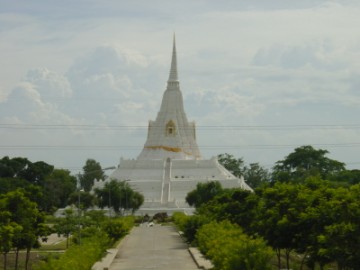
The first site we visited was Phu Khao Thong (the northwest of the island). It was originally built by the Burmese during a 15-year occupation of Ayuthaya but was later retrofitted by the Thais to celebrate the occupier's ouster.
Our full day tour Ayutthaya an ancient captial city consisted of a visit to Wat Phu Khao Thong or the “Monastery of the Golden Mount”. This temple is located outside the city of Ayutthaya. It was built by King I-Thong in 1357 for meditation. In 1592 King Naresuan defeated the Burmese crown prince. He commanded a large pagoda be built at this temple to match the height of the temple.
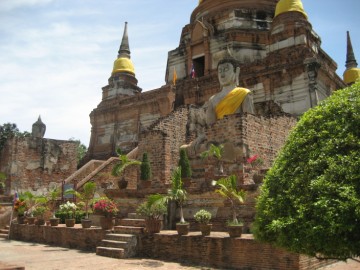
The next site we visited was the Wat Yai Chai Mongkhon (east of isaldn) a 7m-long reclinging Buddha is the defining feature of this temple, built by King U in 1357 to house Sri Lankan monks. The bell-shaped chedi (stupa) was later built to honour King Naresuan's victory over Burma.
We also visited Wat yai Chai mong khon or the “Great Monastery of Auspicious Victory” thai temple is located outside the city of Ayutthaya. Evidence of a large moat that once existed around the site suggests that it was once an important Khmer-style temple complex in “Ayodhya,” a settlement that pre-dated the Ayutthaya Kingdom.

The tall chedi that stands an estimated 30 meters (100 feet) is almost as high as the one at Wat Phu Khao Thong; its more slender profile that rises in the middle of urban Ayutthaya obscures its true height.
Today it’s a functioning temple with a monastery and restored stupa or chedi (monument). Several smaller chedi ruins dotting the grounds serve as a reminder that the site is historical.
It was built by King U-thog in 1357 for meditation.


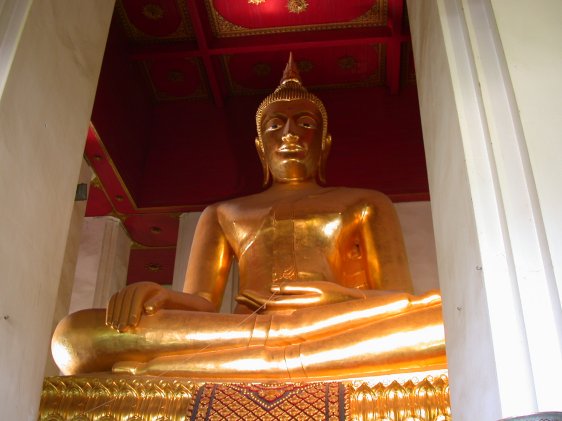
We took a lunch break consisting of traditional Thai food and then proceeded to Wat Lokaya Sutha.
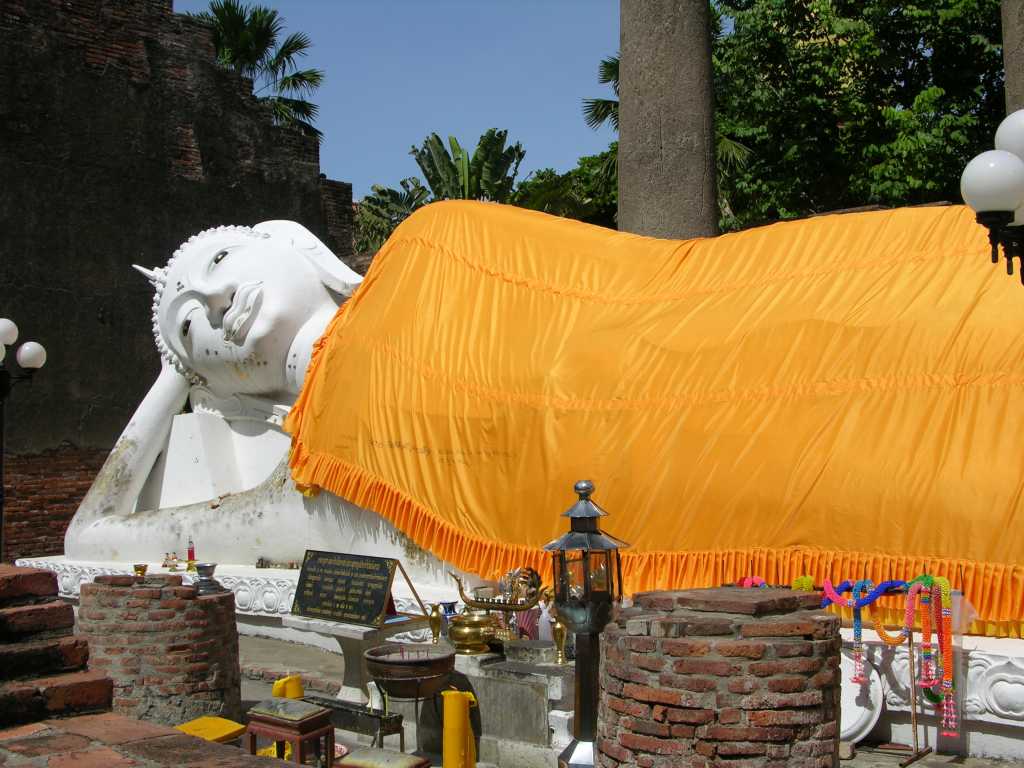

After a day of being immersed in Buddha images, temples and stupas, we were dropped off in a different part of Bangkok "accidentally".
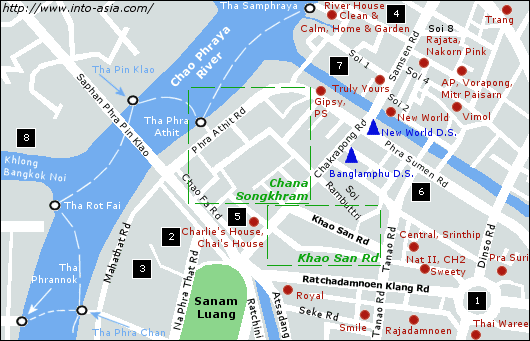
This proved to be a wonderful mishap as we discovered a very 'funky' part of Bangkok, the Banglamphu area which is near the River.
We took this opportunity to explore the various hotels, Guest Houses, and to book a hotel for our return to Bangkok before going back to the Guest Home.

No comments:
Post a Comment