We leave our hotel room 6.00 a.m. in
the morning in a Tuk Tuk heading toward the airport. It was still dark
and everyone was on their way to work. Lucky for us (?) we were going
in the opposite direction. On a very narrow bridge, our Tuk Tuk had to
stop often to let the other side go by as both of us would not fit the
width of the bridge. Our flight was great. Laos Airlines manages to
feed us a 'meal' on a one-hour flight. They automatically put the tall
men at the front of the small airplane so that they would have room for
their legs.
We arrived at Siem Reap and began the task of
finding a Guest House. The search seemed long and tiring in the very
hot weather. It seems that each location we arrive at brings on another
layer of even hotter weather.
Gerald found a Tuk Tuk driver who would
drive him around for a $1.00 to look for a Guest House.
He found one in
the Psar Chaa part of town, which is where we wanted to stay. The
Villa Medamrei was an oasis in the dessert. It has an eye-catching
exterior which sets the tone for a stylish and affordable boutique stay.
The room included a flat-screen TV and bright silk decor, beautiful
ponds/gardens and reclining spaces with a very attentive staff. We were
welcomed with a drink and treats when we checked in. The Guest House
was a welcomed change from some of our previous accommodations.
Having
checked in, we hired the Tuk Tuk driver for the next two days to begin
our visit and exploration of the Temples of Angkor.
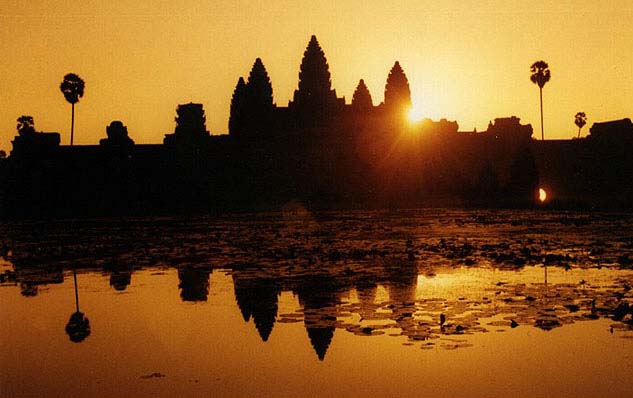
Angkor is the
earthly representation of Mt. Meru, the Mt. Olympus of the Hindu faith
and the abode of ancient gods. The temples are the perfect fusion of
creative ambition and spiritual devotion. The Cambodian 'god-kings' of
old each strove to better their ancestors in size, scale and symmetry,
culminating in the world's largest religious building, Angkor Wat.
The
temples of Angkor are a source of inspiration and national pride to all
Khmers as they struggle to rebuild their lives after years of terror
and trauma. Today, the temples are a point of pilgrimage for all
Cambodians, and no traveller to the region will want to miss their
extravagant beauty. Angkor is one of the world's foremost ancient
sites, with the epic proportions of the Great Wall of China, the detail
and intricacy of the Taj Mahal and the symbolism and symmetry of the
pyramids, all rolled into one. It is truly an unbelieveable,
breath-taking experience to visit these sites.
The Angkorian
period spans more than 600 years from AD 802 to 1432. This incredible
age saw the construction of the temples of Angkor and the consolidation
of the Khmer empire's position as one of the great powers in southeast
Asia. This era encompasses periods of decline and revival and wars with
rival powers in Vietnam, Thailand and Myanmar. This brief history
deals only with the periods that produced the temples that can be seen
at Angkor.
The hundreds of temples surviving today are but the
sacred skeleton of the vast political, religious and social centre of
Cambodia's ancient Khmer empire, a city, that at its peak, boasted a
population of one million when London was a small town of 50,000. The
houses, public buildings and palaces of Angkor were constructed of wood -
now long decayed - because the right to dwell in structures of brick or
stone was reserved for the gods.
To begin our visit
at the Temples of Angkor, we decided to take the Tuk Tuk driver's
suggestion and do what is called the
'Big Circuit'. The 'Big Circuit'
of the Temples of Angkor is 26km and is an extension of the Small
Circuit, which is 17 km. As part of the 'Big Circuit' we explored the
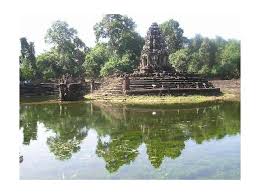
Buddhist-Hindu fusion temple of Preach Kan and the ornate water temple
of Neak Poan, Ta Prohm, the Ta Prohm before continuing to the temple
pyramid of Ta Keo, the Buddhist monastery of Banteay Kdei and the
immense royal bathing pond of
Sra Srang.

The name means royal bathing pond. The first lake, built in the 10th
century, may have been larger. This lake, built during the reign of
Jayavarman VII, is about 400 by 700 meters, and is bordered with steps
and a stone facing. It is across the road from the east entrance to
Banteay Kdei, the Buddhist sanctuary also built by Jayavarman VII.
Originally there may have been a small island sanctuary in the center of
this tranquil "baray" since blocks of large stones have been found in
the water there.
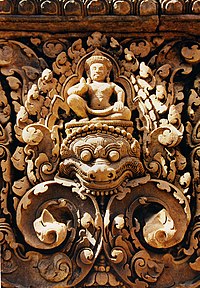
Next we ventured to
Banteay Srei temple, the jewel in the crown of Angkorian art and
Beng Mealea, a
remote jungle temple. Consecrated on the 22nd of April, 967 A.D.
[4], Bantãy Srĕi was the only major temple at
Angkor not built by a monarch; its construction is credited to a courtier named
Yajnavaraha / Yajñavarāha (modern
Khmer:
យជ្ញវរាហៈ), who served as a counsellor to king
Rājendravarman II (modern
Khmer:
ព្រះបាទរាជេន្រ្ទវរ្ម័ន).
The temple's modern name,
Bantãy Srĕi — citadel of the women, or citadel of beauty — is probably related to the intricacy of the
bas relief carvings found on the walls and the tiny dimensions of the buildings themselves.
[6] Some have speculated that it relates to the many
devatas carved into the walls of the buildings.
[7]
Beng Mealea or
Bung Mealea (
Khmer:
ប្រាសាទបឹងមាលា, its name means "lotus pond"
[1]) is a temple in the
Angkor Wat style located 40 km east of the main group of temples at
Angkor,
Cambodia, on the ancient royal highway to
Preah Khan Kompong Svay.
Its primary material is
sandstone
and it is largely unrestored, with trees and thick brush thriving
amidst its towers and courtyards and many of its stones lying in great
heaps.
Upon the suggestion of our driver , we then
proceeded to walk uphill, then climb the
Phnom Bakheng ancient temple
to view the sunset.
It is an incredible feeling to be perched high on
an ancient temple overlooking the city Siam Reap and Angkor Wat as the
sun goes down.
What an amazing day it was. Before saying goodbye to
our driver for the evening, we made arrangements for him to pick us up at
5.00 am. to view sunrise at Angkor Wat.
The evening was spent
exploring Siam Reap, which included a delicious Cambodian dinner and
visiting the Night Market. The Night Market is packed with stalls
selling a variety of handicrafts, souvenirs and silks.
It is also
possible to get a foot massage, a back massage and have fish eat the
dead skin off your feet if you wish at the very busy market.